Forward to Phone Number
Direct your FlyNumber's incoming calls to any standard phone number worldwide. The simplest of the call-handling options — pick a destination, save, and your FlyNumber rings whichever phone you've pointed it at.
Anything reachable on the regular phone network is fair game as a destination: a building's legacy intercom, an apartment paging system, a gate or garage-door controller wired to a phone line, an alarm panel, a fax machine. If it answers a phone call, your FlyNumber can dial into it.
Setting it up
You can choose Phone Number as your forwarding type two ways: when you first add a FlyNumber, or anytime afterwards from the number's detail page. Both flows use the same form, so the format rules below are identical either way.
When you add a FlyNumber
During the Add FlyNumber flow, the Call handling step asks how you want to handle incoming calls. Pick Phone Number, enter the destination, and continue. You don't have to lock anything in here — the choice is fully editable from the panel afterwards.
From an existing FlyNumber
To change forwarding on a number you already have:
- Open My FlyNumbers in the sidebar (or panel.flynumber.com/my-flynumbers).
- Click the number you want to update.
- In the Call Handling card, select Phone Number.
- Enter the destination in the Destination Phone Number field.
- Click Save Settings.
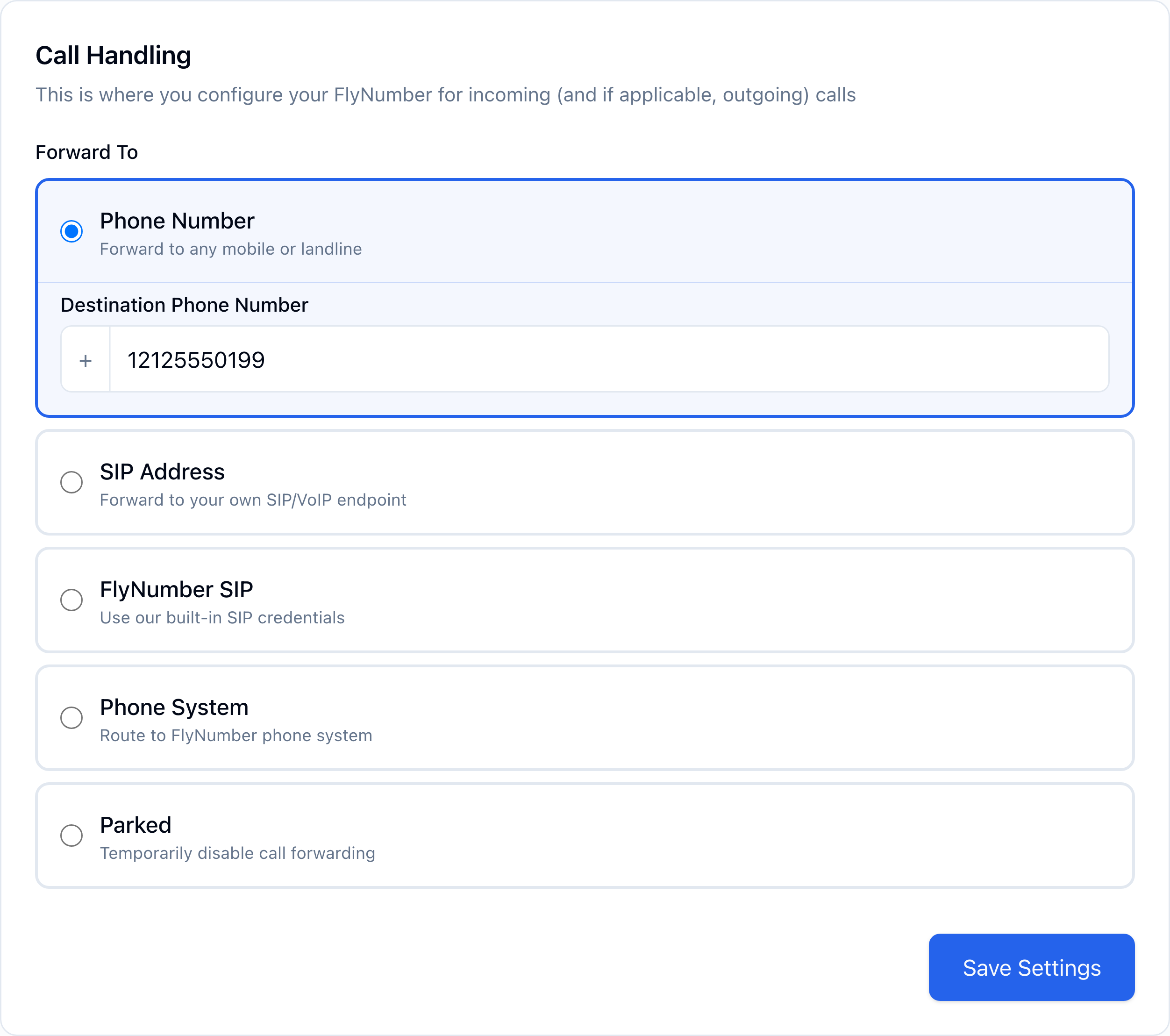
The change takes effect as soon as you save — no waiting period, no impact on calls that are already in progress.
Number format
Type digits only, including the country code. The panel adds the + prefix for you and validates the result against international numbering rules.
- Correct:
12124567890 - Incorrect:
+1 212 456 7890,(212) 456-7890,212-456-7890
12... is a US number (country code 1); use 44... for the UK, 49... for Germany, and so on.
If your number doesn't pass validation you'll see "Enter the full number with country code (e.g., 12124567890)" — usually a missing country code or a stray space/dash that snuck through.
Per-minute rates
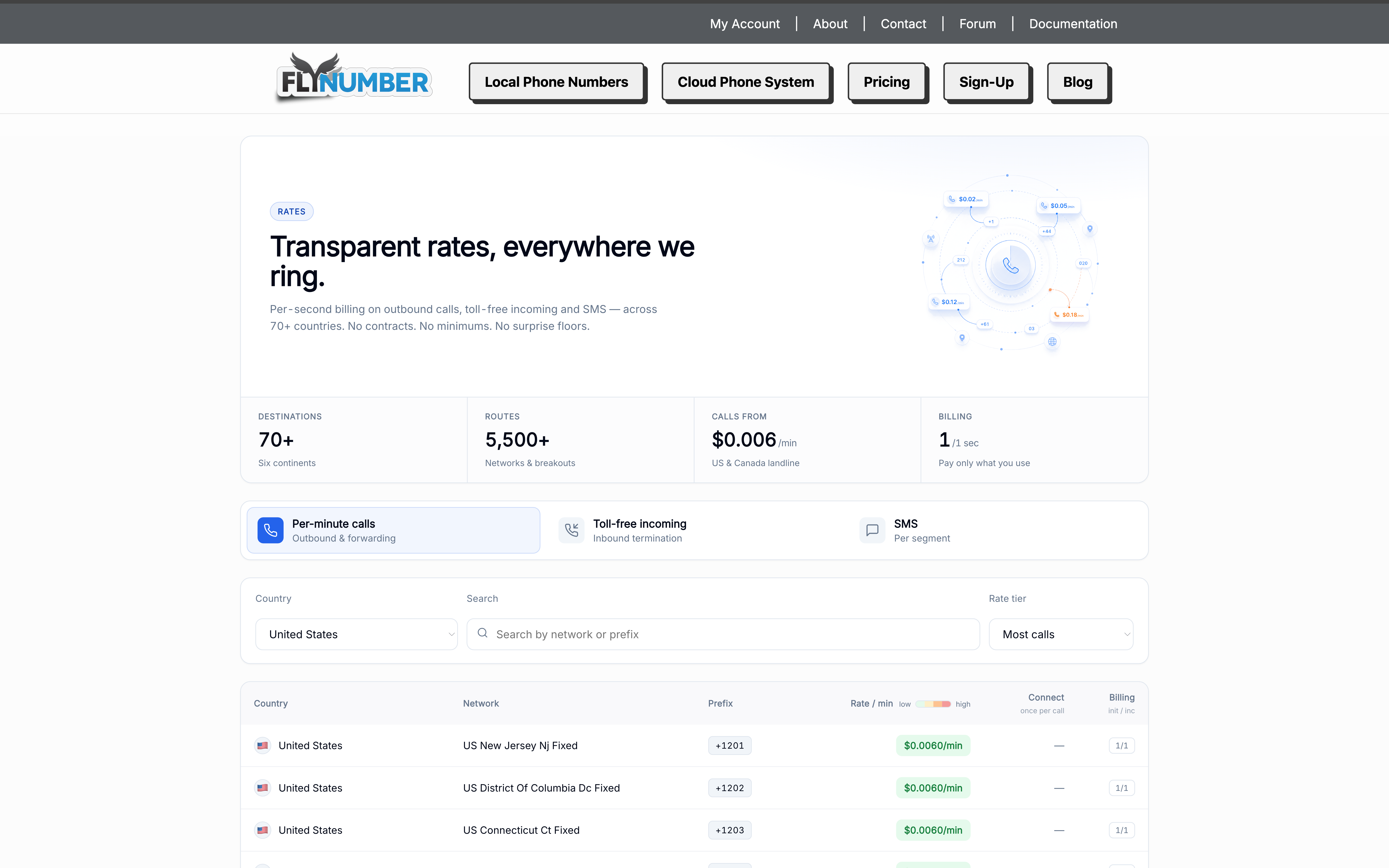
Forwarding to a regular phone deducts a small per-minute charge from your prepaid balance. See the full per-minute rates page for current pricing — quick reference:
| Destination | Approximate rate (USD/min) |
|---|---|
| US / Canada | $0.02 |
| UK Mobile | $0.08 |
| Other countries | Varies |
Caller ID behavior
When forwarding to a regular phone, we pass the original caller's caller ID through to the destination. A few things to know:
Anonymous and blocked callers
When someone calls your FlyNumber with their number withheld (anonymous, blocked, or private) and you forward to a regular phone, the call still connects. Your phone shows your FlyNumber as the caller instead of "Private", because carriers do not accept forwarded calls without a caller ID. The same applies to calls that arrive with an invalid or malformed caller ID. Your call log in the panel still records the call as anonymous.
Same-country routing
Some carriers block calls when the caller's location and the forwarding destination are in the same country, even if your FlyNumber is from a third country. The routing pattern can trip carrier fraud-prevention systems.
For example: caller in Country A → FlyNumber in Country B → forwarded back to Country A. Carriers occasionally block this loop.
What you might see:
- Calls showing as "busy" or failing to connect
- The forwarding destination never receives the call
- Inconsistent behavior depending on the caller's carrier
Call loop prevention
If your FlyNumber forwards to a phone number, do not call your FlyNumber from that same phone. The call has no valid destination and won't connect.
When you call your FlyNumber from the number it forwards to, the system attempts to route the incoming call right back to where it originated. The circular path has no valid endpoint, so the call fails.
What you'll see:
- A Busy status with reason Line busy in your Call Logs
- The call doesn't ring on either end
How to test forwarding properly:
- Call from a phone that isn't the forwarding destination
- Use a different mobile carrier or landline
- Try calling from a VoIP service or a second device
Troubleshooting failed calls? Check your Call Logs for Busy / Line busy entries and confirm the caller's number isn't your forwarding destination.
Workarounds
If anonymous callers, same-country routing, or call loops are causing real issues, consider these alternatives:
- Forward via VoIP — VoIP delivers calls regardless of caller-ID state, bypasses same-country restrictions, and routes more reliably internationally.
- Set the number to the cloud phone system — gives you multiple destinations, fallback options if a leg fails, and per-caller routing rules.
Best practices
Tips for reliable phone forwarding
- Verify your number — double-check the destination digits before saving. A typo silently sends calls into the void.
- Test with a different phone — call from a number that isn't your destination, on a different carrier ideally.
- Watch your prepaid balance — forwarding charges deduct as calls happen; an empty balance means dropped calls.
- Monitor call logs — quick way to spot anonymous-call drops or routing weirdness.
- Move to VoIP if calls are flaky — VoIP handles edge cases that PSTN forwarding can't.
- Wrong number format = no calls forwarded. Type digits only, with country code.
- International rates vary by country.
- Callers who withhold their number still connect; your phone shows your FlyNumber as the caller.
- Same-country routing can trigger carrier blocks.
- Calling your FlyNumber from its destination phone creates a loop and won't connect.
- For more reliability, consider VoIP forwarding or the cloud phone system.
What's next?
Once your forwarding is set:
- Make a test call from a different phone to verify.
- Check your call logs to see the call land.
- Curious about more advanced setups? See the cloud phone system.
For features like:
- Auto-attendants and voice menus
- Multi-destination ringing
- Time-based routing
- Custom greetings
- Better handling of anonymous callers and routing edge cases
Take a look at the cloud phone system.