Queue
The Queue module manages incoming calls by placing them in a waiting line until a team member is available. Perfect for call centers and busy departments, it ensures callers are handled efficiently while providing a professional waiting experience.
- Call center management
- Customer support lines
- Sales team distribution
- High-volume call handling
- Department call routing

Setting It Up
General Settings
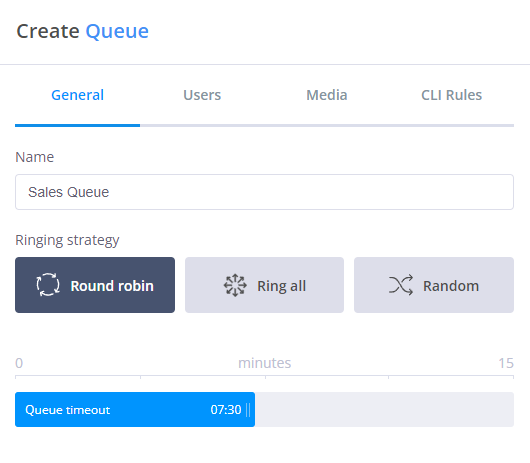
-
Name: Give your queue a descriptive name (e.g., "Sales Queue" or "Support Line")
-
Ring Strategy:
- Round Robin: Rings destinations one at a time, in order. The queue remembers the last destination it tried, so the next call starts with the following one: if call A tried destinations 1, 2 and 3, call B starts at destination 4 and continues down the list
- Ring All: Rings every destination at the same time, each for the queue destination timeout
- Random: Randomly selects one team member to ring
-
Queue Timeout: Set maximum call handling time
- Default: 7 minutes 30 seconds
- Range: 5 seconds to 15 minutes
- Calls exceeding this time follow the timeout path
- Connect to voicemail or alternate handling. If nothing is connected to the timeout cable, the call ends when the timeout expires
Users Tab
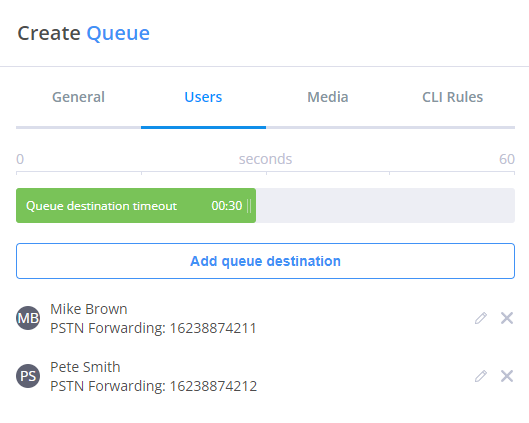
Add team members who will receive calls:
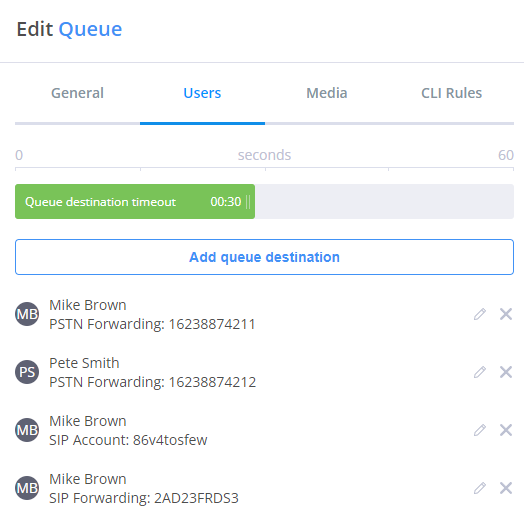
- Click Add queue destination and pick a user and one of their contact methods (set up under Contact Methods)
- Add multiple contact methods per user — there's no fixed cap on queue destinations, unlike a Ring Group, which rings up to 10. With Ring All, at most 10 ring at the same moment
- Queue destination timeout: how long each destination rings before the queue moves on (0 to 60 seconds). It applies to all three ring strategies and is separate from the queue timeout, which limits the call's total time in the queue
- Remove a destination with the X next to it, then click Save
Many softphones give up on a call that rings for the full 60 seconds (SIP 408 Request Timeout). Setting the queue destination timeout to 55 seconds or less avoids this.
Media Tab
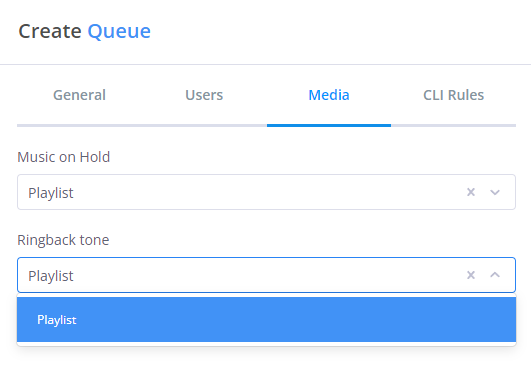
Configure audio for waiting callers:
-
Music on Hold: Played during wait time
- Upload custom audio files
- Create playlists
- Supported formats: .mp3, .m4a, .wav, .flac, .ogg
-
Ringback Tone: Played before call is answered
- Company messages
- Marketing announcements
- Position announcements
CLI Rules
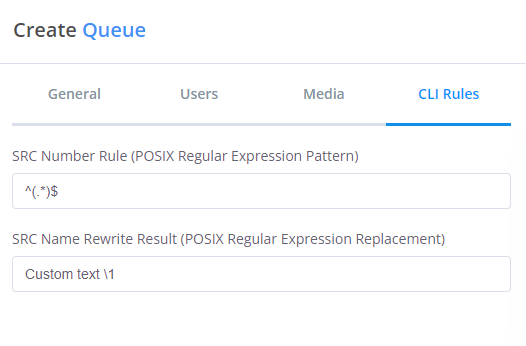
Customize caller ID display:
Example 1: Set custom text
Rule: ^(.*)$
Result: Support Queue

Example 2: Add prefix
Rule: ^(.*)$
Result: Queue Call - \1
Practical Example
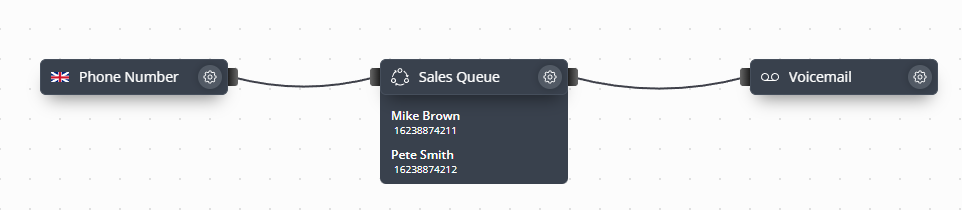
This example shows:
- Calls arrive through a phone number
- Queue manages distribution to team members
- Unanswered calls go to voicemail
- Set appropriate timeout values
- Record clear waiting messages
- Configure fallback options
- Monitor queue performance
- Balance team workload
- Update member list regularly
Ring Strategies Explained
| Strategy | How It Works | Best For |
|---|---|---|
| Round Robin | Rings destinations one at a time, picking up where the previous call left off, until someone answers or the queue timeout (default 7:30, max 15:00) is reached | Even workload distribution |
| Ring All | Rings all destinations at once for the destination timeout. Destinations that were busy or temporarily unavailable may be tried again while the call is still in the queue; otherwise the call moves on to the timeout path | Urgent calls, quick response needed |
| Random | Randomly selects one member to ring | Basic load balancing |
- Queue timeout: Maximum call handling time (default 7:30, max 15:00)
- Destination timeout: Individual member ring time
- Media settings: Keep callers informed during wait
- Member list: Keep updated for proper distribution
- Round Robin: Continues through the list until someone answers or the queue timeout is reached
Advanced Features
- Multiple contact methods per member
- Custom audio messages and music
- Flexible timeout handling
- CLI rule customization
- Team member management
- Queue status monitoring